

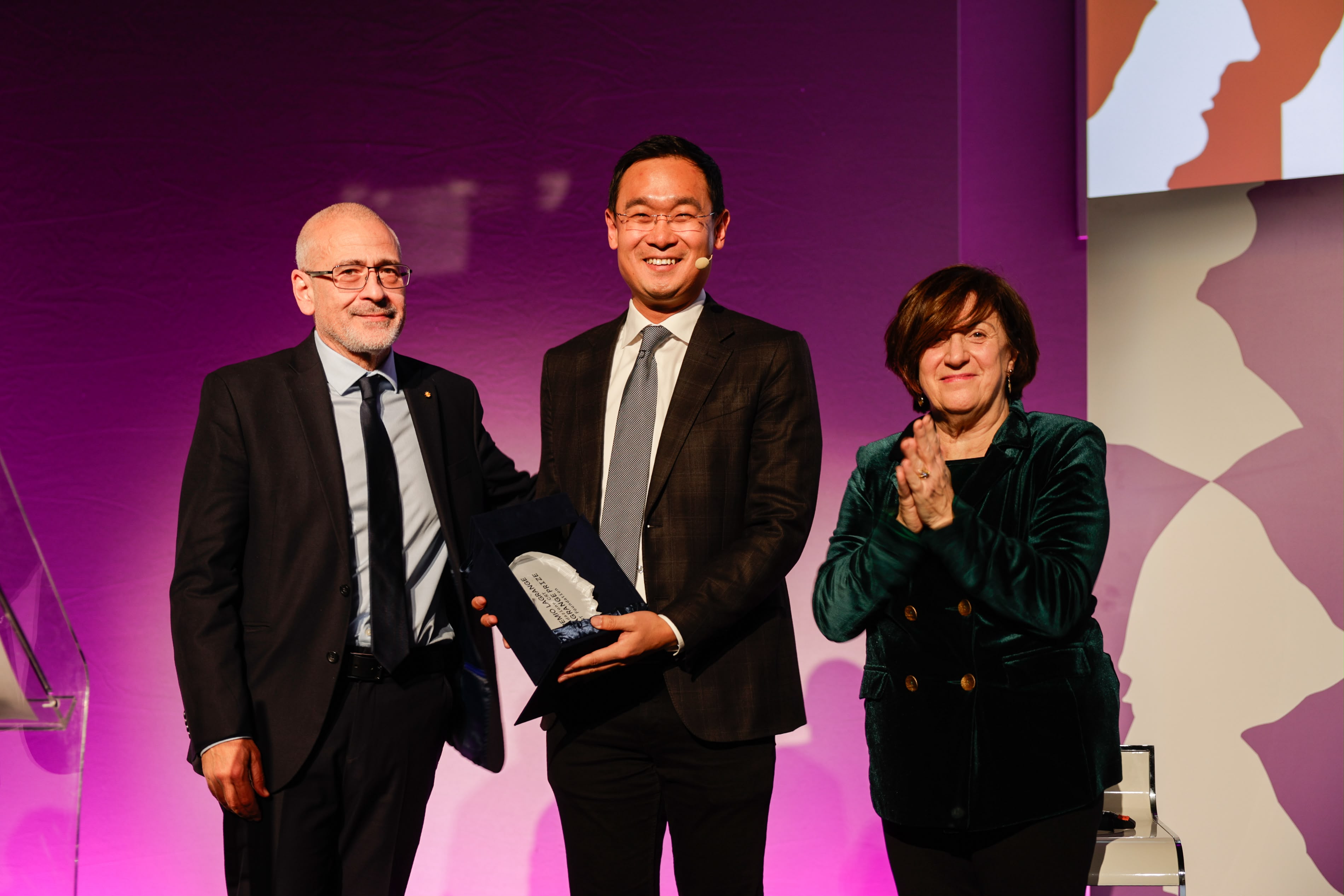
(Photo credit: Luigi De Palma)
Dashun Wang, the Kellogg Chair of Technology at Northwestern University’s Kellogg School of Management and Co-Director of the Ryan Institute on Complexity, has received the 2026 Lagrange–Fondazione CRT Prize, presented November 3 in Turin, Italy.
The prize, established by Fondazione CRT and coordinated by the ISI Foundation, is one of the world’s leading honors in complex systems. Past recipients include Nobel laureate Giorgio Parisi and mathematician Yakov Sinai.
Wang is a leading figure in the “science of science,” a field that uses large-scale data, AI and complexity science to study how discoveries emerge. As founding director of Northwestern’s Center for Science of Science and Innovation, Wang has uncovered surprising patterns behind scientific breakthroughs: why creative success often comes in bursts, why small teams are more likely to produce disruptive ideas, and how AI could make scientific research more efficient while potentially discouraging originality.
Hot streaks: explore, then focus
Wang and his team found that high-impact work clusters in time, a pattern they call a “hot streak.” About 90% of scientists, 91% of artists and 82% of film directors studied experienced at least one. Einstein’s 1905 “miracle year” is the classic example; Peter Jackson’s came while directing The Lord of the Rings.
The idea took shape at the Van Gogh Museum in Amsterdam. Wang noticed that Van Gogh’s work was highly varied before his 1888 move to the south of France. After the move, it became far more focused, just as his hot streak began. In a follow-up study, the team tested that observation across thousands of careers. They found that a period of exploration followed by focused exploitation consistently predicts the onset of a hot streak.
Small teams disrupt, large teams develop
In another study of more than 65 million papers, patents and software products, Wang and colleagues found that small teams are more likely to produce disruptive ideas. Large teams excel at developing and scaling existing ones.
One likely reason is risk: truly disruptive ideas are often risky, and it is easier for a few people to take that bet together than to build the same consensus across a team of hundreds. Large teams, in turn, bring the expertise, resources and coordination needed to solve complex problems at scale.
“We need both,” Wang said. “But as science increasingly moves toward large collaborative projects, we need to make sure small teams are not squeezed out. If we only fund large teams, eventually there may be fewer new ideas for them to build on.”
AI and the risk of conformity
A 2026 study by Wang and colleagues in the Proceedings of the National Academy of Sciences (PNAS) examined the National Institutes of Health (NIH) and the National Science Foundation (NSF) grant proposals submitted from two major U.S. universities between 2021 and 2025. At NIH, proposals with stronger signs of AI use were about four percentage points more likely to win funding; at NSF, the difference was not significant. At both agencies, AI-assisted proposals more closely resembled previously funded work.
The results raise a troubling possibility: AI may help researchers secure funding while reinforcing established scientific directions at the expense of more unconventional ideas.
“I think that is a real risk, but it is not an argument against using AI in science,” Wang said. “The question is not whether to use AI, but how we use it and what we reward when we do. Funding and evaluation systems need to leave room for ideas that look unfamiliar or risky.”
Wang also sees AI’s potential to transform scientific discovery. In a recent Nature essay, he described AI agents as “airplanes for the mind,” capable of expanding the scale and scope of scientific research while emphasizing the importance of human oversight and collaboration.
These questions are part of Wang’s broader effort to understand the forces shaping scientific discovery—a body of work now recognized by the Lagrange Prize.
“It is a tremendous honor, and very humbling,” Wang said of the Lagrange Prize. “I also see this as recognition of the science of science as part of the broader intellectual tradition of studying complex systems.”
“Above all, this is a collective effort,” he added. “The work would not have been possible without my students, colleagues, mentors, and collaborators.”

