

Universities produce a vast number of scientific publications each year. Yet only a small share ultimately leads to patents, startups, or broader industry adoption. The challenge is not a shortage of ideas, but limited visibility into which discoveries — and the researchers behind them — are most likely to move toward commercialization.
A new platform developed at the Northwestern Innovation Institute, called InnovationInsights, is designed to make that hidden potential visible.
Using artificial intelligence and large-scale research data, the system helps technology transfer offices identify faculty, papers, and emerging research areas with strong commercial promise — including many discoveries that would otherwise remain outside the innovation pipeline.
At the core of the platform is a searchable interface built around two levels of insight: researchers and their individual publications.
Users can explore researcher profiles that bring together key signals related to translational activity, including publication history, recent high-impact work, invention disclosures and whether a researcher’s papers have been cited by company patents. These profiles allow innovation teams to quickly identify faculty whose work is influencing industry or to show patterns associated with future commercialization.
At the publication level, InnovationInsights assigns each paper a commercial potential score based on machine-learning models trained on decades of historical data linking research outputs to downstream outcomes. Users can rank papers by this score to identify emerging discoveries that may be ready for translation, even before any patent activity occurs.
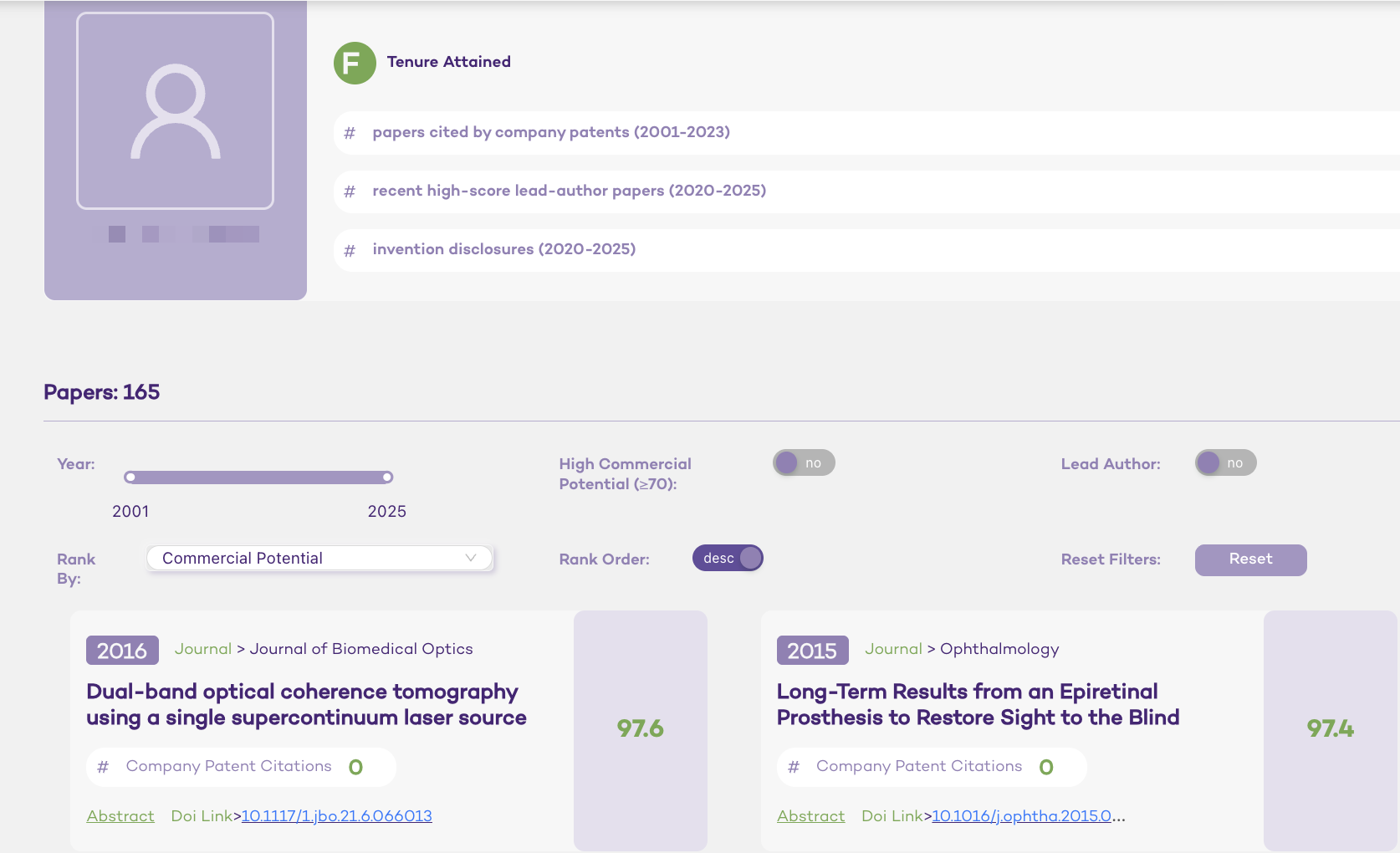
The platform also tracks citations from company patents, offering a direct view of where academic research is being used in industrial innovation. By comparing commercial potential scores with patent influence,institutions can see both future opportunity and current industry relevance.
Additional filters allow users to narrow results by year, author role, or threshold levels of commercial potential, making it possible toscan large research portfolios and quickly identify most promising opportunities.
The goal is to shift technology transfer from a passive process — waiting for faculty disclosures — to a more proactive, data-informed strategy.
At Northwestern, the system was used to identify nearly 150 tenure-line faculty members whose research showed strong commercial signals but who had not recently engaged with the university’s technology transfer office. We then conduct a preregistered randomized field experiment using AI models and low-cost human outreach. Targeted outreach based on their high-potential papers yielded a response rate of more than 70 percent. Within months, the group generated new invention disclosures at more than twice the rate of a comparable control population.
The results suggest that many commercially promising ideas remain untapped, not because they lack value, but because the researchers behind them have never been directly engaged.
The project reflects a broader shift in how universities manageinnovation. As research output continues to grow, traditional methods based on individual networks or departmental referrals make it difficult to see the full landscape of opportunities. Data-driven systems offer a way to surface overlookedtalent, emerging fields and early signals of industry relevance.
Across institutions, the implications could be significant: a substantial share of high-potential research may never reach commercialization channels without targeted identification and engagement.
Related work: How I’m using AItools to help universities maximize research impacts

.png)